Liberty Virtual Courtroom: Built To Run Court Hearings
A virtual courtroom built from the ground up to efficiently manage court proceedings
Courts didn’t set out to become experts in video conferencing. But when the pandemic forced court hearings online, they had no choice. Platforms like Zoom, Microsoft Teams, and Webex quickly filled the gap, but they were never designed for court proceedings. They were built for business meetings, not court hearings or due process. That distinction matters, and it’s exactly where the Liberty Recording’s Liberty Virtual Courtroom (LVC) stands apart.
Liberty Virtual Courtroom is not a repurposed conferencing tool.
It is a purpose-built judicial platform, developed from the ground up by Liberty Recording, a company with deep roots in court recording technology and a significant footprint across the U.S. court system. With decades of experience replacing legacy tape systems such as Sony BM246 decks, VHS, and DVR-based recording setups, Liberty saw what the major conferencing providers missed: courts are not meetings. They are structured, high-stakes environments where workflow, record integrity, and control are everything.
Built for Courts, Not Adapted to Them
Zoom and Teams surged during COVID because they were available, not because they were ideal. Courts improvised, using waiting rooms as makeshift lobbies, juggling links, and manually coordinating participants. “Zoom bombing” incidents and security concerns highlighted the risks of using general-purpose tools in judicial settings.
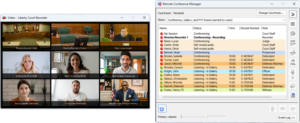
Liberty Virtual Courtrooms takes a fundamentally different approach. Every feature is designed around how courts actually operate. Instead of sending out meeting links and hoping participants land in the right place, LVC provides a centralized Conference Manager. In this live control interface, clerks can see everyone in the system, manage access, and instantly move participants between spaces.
If someone joins the wrong courtroom? Move them with a click. If a judge becomes unavailable? Transfer the case to another courtroom or reassign the judge seamlessly. This level of control eliminates the chaos that courts experienced with traditional conferencing tools.
True Courtroom Workflow, Digitized
One of the most transformative aspects of LVC is how it replicates – and improves upon – real courtroom workflow.
In a physical courthouse, multiple things happen at once: a case is being heard, the next case is being prepared, interpreters are being coordinated, and clerks are managing logistics. Traditional platforms force all of this into a single-threaded process, often requiring phone calls, emails, or separate meetings.
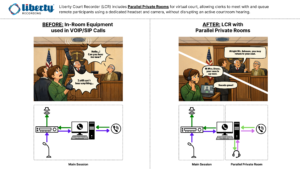
Liberty changes that with parallel private rooms. While one case is in session, a clerk can simultaneously connect with an interpreter or attorney in a separate private space, without interrupting the active proceeding or recording. Everything happens in the same application, eliminating the need for external tools or manual coordination.
This isn’t just convenience. It’s operational efficiency. Courts report significant reductions in administrative overhead, allowing clerks to focus on managing cases rather than managing technology.
Recording and Transcription That Meets Legal Standards
Recording isn’t an add-on in Liberty Virtual Courtrooms. It was designed to work as an extension of the Liberty Court Recorder. It’s a recorder-centric architecture, not a meeting-centric one. The needs of a court, how the system supports court transcription, and the official record are foundational.
Unlike Zoom or Teams, which typically provide a single mixed audio track, LVC can record isolated audio channels for each participant. This capability is critical for legal proceedings, where clarity, accountability, and transcript accuracy are paramount. In fact, only a handful of providers are certified to meet these standards in state and federal courts.
Beyond multichannel recording, Liberty captures rich metadata in a single authoritative recording file: connection logs, participant actions (muting, video changes, drop-offs), and more. During the pandemic, courts frequently struggled to determine whether the system or the participant caused technical issues. With LVC, that ambiguity disappears. The data tells the story.
No Hardware, No Complexity
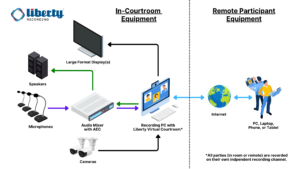
Another key advantage is simplicity. Liberty Virtual Courtrooms is entirely software-based. No additional hardware is required. Courts can deploy it quickly, often at a cost comparable to or even lower than government-tier Zoom accounts.
Pricing is straightforward: typically a per-room annual cost that includes the full feature set, including recording. There’s no “nickel-and-diming” based on users or meeting links. It’s designed to scale with the courtroom, not complicate it.
The system also supports modern AV standards like NDI and Dante, ensuring compatibility with existing infrastructure.
Designed Around Real Users
One of Liberty’s most overlooked advantages is its professional services approach. This isn’t a company that sells software and walks away. Their team works directly with courts—shadowing staff, analyzing workflows, and configuring the system to match real-world needs.
This hands-on approach leads to rapid adoption. Many courts become self-sufficient within weeks, with minimal ongoing support required. When changes are needed, they’re often implemented in minutes—not months.
A notable example is the DC DMV, which operates one of the largest LVC deployments, with 42 virtual courtrooms that handle parking hearings. When they needed to reintroduce permit control and show-cause hearings, features absent during years of using Webex, Liberty added them almost immediately.
A Courtroom Experience, Not Just a Call
Liberty Virtual Courtrooms also recreates the experience of being in a courthouse. Custom branding ensures participants see the court’s identity rather than a third-party platform. Features like virtual signage, information desks, and multilingual interfaces (including full localization for Spanish and other languages) make the system more accessible and intuitive for the public.
Even participation modes are tailored. For example, the gallery allows attendees to listen without the ability to interact or disrupt the proceedings. Courtroom decorum is preserved in the digital environment.
The Future of Virtual Courtrooms
With multiple successful pilot programs and more than two years in operation, Liberty Virtual Courtrooms proves that courts don’t have to settle for tools that were never meant for them.
Zoom and Teams helped courts survive a crisis. Liberty helps them evolve beyond it.
By combining purpose-built design, a deep understanding of judicial workflows, and advanced recording capabilities, Liberty Virtual Courtrooms delivers something fundamentally different. Not just a way to meet online, but a better way to conduct court hearings, support accurate court transcription, and expand access to justice in a modern, digital-first world.
Talk to Us About Your Project
Too busy to chat right now?
Send us a message.